EN
EN

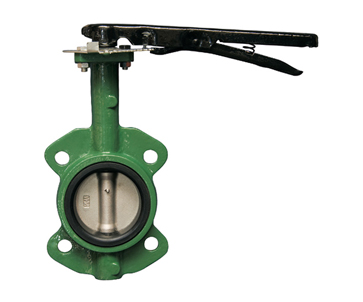
Butterfly valves are widely used in large-diameter pipelines because their compact structure, short face-to-face dimension, relatively low weight, and quarter-turn operation make them practical for controlling high flow volumes without requiring the space and heavy valve body associated with many alternative designs.
For water treatment, power generation, mining, chemical processing, oil and gas, and other industrial systems, these advantages become increasingly important as pipeline diameter increases. Hebei Leading's butterfly valve range, for example, covers sizes from 1½" to 48" with wafer, lug, double-flanged, U-section, and grooved connections.
Valve size affects much more than flow capacity. As pipeline diameter increases, valve weight, installation space, actuator requirements, pipe support loads, and maintenance access all become important engineering considerations.
Butterfly valves address these challenges through a relatively simple construction consisting primarily of a body, disc, stem, and seat. Their short structural length and lower weight make large valves easier to integrate into a piping layout. Hebei Leading specifically identifies compact dimensions, light weight, quick operation, and relatively small operating torque among the advantages that make butterfly valves suitable for large diameters.
This is one reason the application of valve in industry often shifts toward butterfly designs when engineers need economical isolation or flow regulation on large water, cooling, process, or utility lines.
There is no universal winner; the correct choice depends on the operating conditions.
A butterfly valve is generally attractive when the project prioritizes:
Compact installation
Lower valve weight
Rapid quarter-turn operation
Easier actuation
Flow regulation as well as isolation
Economical large-diameter construction
A gate valve may be preferable when an unobstructed full-bore flow path and very low pressure loss in the fully open position are especially important.
This distinction matters because a butterfly valve disc remains inside the flow path even when fully open. Hebei Leading's technical guidance notes that pipeline pressure loss should therefore be evaluated carefully when selecting a butterfly valve.
In practice, engineers should compare valve purchase cost, pumping requirements, installation weight, available space, shut-off performance, and maintenance requirements rather than selecting a valve only by nominal diameter.
Yes, butterfly valves can provide both shut-off and throttling functions, provided the valve is correctly sized for the operating conditions.
The mistake is to select a butterfly valve solely because its nominal diameter matches the pipeline. For throttling service, engineers should consider expected flow rate, differential pressure, operating angle, fluid velocity, cavitation risk, and actuator control requirements.
A valve that operates continuously near an unsuitable disc position may experience excessive vibration, unstable control, or accelerated seat and disc wear.
For this reason, valve sizing should be based on actual system conditions rather than pipe diameter alone.
Lever operation becomes increasingly impractical as valve diameter and required operating torque increase.
Gear-operated butterfly valves use mechanical reduction to make opening and closing easier. Hebei Leading notes that lever operation can become difficult on larger valves, while gear operation is suitable for both large and small butterfly valves.
Depending on the project, large-diameter valves may use:
Worm gear operators
Pneumatic actuators
Electric actuators
Hydraulic actuators
The actuator should be selected according to required torque, operating frequency, closing speed, automation requirements, and emergency operating conditions.
The connection design should match the pipeline configuration and maintenance strategy.
Wafer butterfly valves provide a compact installation between pipeline flanges and are commonly selected where space and weight are priorities.
Lug butterfly valves use threaded body lugs and can provide additional flexibility in pipeline installation and maintenance.
Flanged and U-type butterfly valves are often considered where a more robust flange connection is required. Hebei Leading's U-type design is intended to facilitate pipeline centering and is designed with large-diameter and higher-pressure installation conditions in mind.
The final choice should also account for body, disc, stem, and seat materials. Available seat options in Hebei Leading's range include EPDM, NBR, PTFE, Viton, and metal-seated configurations.
When evaluating a butterfly valve for sale, price should not be the first specification considered. A technically correct quotation requires enough information to ensure the valve matches the pipeline.
Buyers should provide:
Nominal valve size
Design and operating pressure
Operating temperature
Process medium
Required connection type
Body and disc materials
Seat material
Manual, gear, pneumatic, or electric operation
Required valve standard
Flange standard and dimensions
Shut-off and flow-control requirements
Providing these parameters at the inquiry stage reduces the risk of receiving a valve that fits the nominal pipe size but is unsuitable for the actual operating environment.
Yes. The disc remains in the flow path when the valve is open, so its effect on system pressure loss should be considered during valve sizing and pipeline design.
Yes. Their compact dimensions, relatively low weight, quick operation, and availability in large sizes make them widely applicable to water supply, cooling water, and wastewater systems.
They can when the body, disc, stem, and seat materials are selected for the specific medium. Stainless steel, coated ductile iron, PTFE, Viton, and other material options can be considered depending on chemical compatibility and operating temperature.
They are often more practical than lever-operated valves because the gearbox reduces the manual effort required to operate the valve.
Butterfly valves have become a practical solution for many large-diameter piping systems because they combine compact construction, manageable weight, rapid operation, flexible actuation, and multiple connection and material options.
However, large diameter alone is not enough to justify the selection. Engineers and procurement teams should evaluate pressure loss, medium compatibility, temperature, seat design, operating torque, connection type, and control requirements together.
Hebei Leading supplies butterfly valves in multiple configurations, materials, seat options, and actuation methods for industrial pipeline projects. Matching these specifications to actual service conditions is the key to achieving reliable operation and long valve life.
 Call us on:
  Email Us:
  No.68 Hezuo Road, Shijiazhuang City, Hebei Province, China