EN
EN

PP flanges are widely selected for industrial piping systems where corrosion resistance, low weight, chemical compatibility, and cost-efficient installation are more important than the high-pressure capability of metal flanges. They are particularly useful in chemical processing, wastewater treatment, electroplating, irrigation, and circulating-water systems.
Polypropylene offers good resistance to many chemicals and greater stiffness and temperature resistance than some other common thermoplastics. This makes a PP plastic flange a practical connection solution when the operating medium and temperature are compatible with the material.
Unlike carbon steel components, PP flanges do not rust. This is important in piping systems exposed to moisture, chemicals, wastewater, or corrosive process environments.
Hebei Leading lists corrosion prevention, erosion resistance, low weight, and chemical stability among the main advantages of plastic flanges compared with steel alternatives.
Polypropylene has very good chemical resistance and is commonly used in chemical-industry piping and aggressive wastewater applications. However, compatibility should always be checked against the exact chemical concentration and operating temperature rather than assuming PP is suitable for every fluid.
Low component weight simplifies transportation, handling, alignment, and installation. This becomes particularly useful where piping systems contain many flange connections or where reducing structural load is important.
A lightweight plastic flange can also be easier to handle during maintenance than a comparable steel component. Hebei Leading specifically identifies lightweight construction as one of the characteristics of its plastic flange range.
PP flanges can provide an economical alternative to corrosion-resistant metal alloys where pressure, temperature, mechanical loading, and chemical conditions remain within the design limits of the plastic piping system.
The key is correct application. Selecting PP solely because it is less expensive can create problems if the service conditions actually require a higher-performance thermoplastic or metal flange.
Chemical plants are one of the most important applications for polypropylene piping components. PP is used in systems handling various process chemicals because of its chemical resistance, while specialized thermoplastics may be required for more aggressive media or higher temperatures.
Typical flange connections may be found around:
Process piping
Chemical dosing lines
Storage tank connections
Pumps and valves
Treatment equipment
PP components are also suitable for many industrial wastewater and water-treatment applications. Hebei Leading lists sewage treatment and circulating-water engineering among the applications for plastic flanges.
For these projects, buyers should check the chemical composition of the water, operating temperature, pressure, flange standard, and gasket material before selecting the connection.
Electroplating and pickling processes can involve corrosive chemicals that quickly attack unsuitable metallic materials. PP is commonly used in chemically demanding environments such as pickling plants, while Hebei Leading also identifies electroplating as an application for its plastic flange products.
Plastic flanges are useful in irrigation and other water-distribution systems because they are lightweight and do not rust. Hebei Leading specifically notes their suitability for underground irrigation and pipe connections.
PP has better temperature capability than some common thermoplastics, but operating temperature must always be evaluated together with pressure and chemical exposure.
AGRU states that its polypropylene materials can be used up to a maximum temperature of 95°C, while also noting that PP becomes more impact-sensitive below freezing. This should not be treated as a universal flange operating limit because allowable conditions depend on material grade, flange design, pressure, and manufacturer specifications.
For project procurement, always use the manufacturer's pressure-temperature data rather than relying only on the general properties of polypropylene.
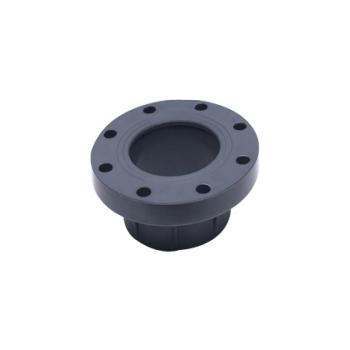
Both PP and PVC are common materials for plastic flanges, and Hebei Leading offers plastic flange products in materials including PVC and PP.
PP may be preferred where higher temperature capability or specific chemical resistance is required. PVC can be a cost-effective option for many water and general chemical-service applications.
The selection should be based on:
Fluid composition
Chemical concentration
Operating temperature
Design pressure
Pipe material
Mechanical loading
Installation environment
Material compatibility is more important than simply choosing the most commonly available plastic.
When evaluating a flange for sale, buyers should provide more than nominal pipe size. The supplier should understand the actual operating conditions.
Confirm the required:
Flange size
PP material grade
Blind or socket configuration
Facing type
Design pressure
Operating temperature
Fluid or chemical medium
Bolt-hole dimensions
Flange standard
Gasket material
Hebei Leading's plastic flange range includes blind and socket types with flat-face configurations and can be supplied according to standards including ANSI/ASME, DIN, BS, JIS, UNI, and EN 1092-1.
Yes. Polypropylene does not rust and offers good resistance to many chemicals, making it suitable for various corrosive piping environments. Chemical compatibility should still be verified for the specific medium.
Yes, flanged connections can be used to connect plastic piping with valves, pumps, tanks, or other equipment when flange dimensions, pressure ratings, gasket selection, and bolting arrangements are compatible.
They are suitable for many chemical services. However, temperature, concentration, pressure, and chemical compatibility must be checked before final material selection.
PP flanges offer lower weight and corrosion resistance, while steel flanges generally provide substantially higher pressure and mechanical-load capability. Hebei Leading's own product information distinguishes plastic and metal flange applications on this basis.
PP flanges are an effective solution when an industrial piping project requires corrosion resistance, chemical compatibility, lightweight installation, and economical operation. Their strongest applications are typically found in chemical processing, wastewater treatment, electroplating, irrigation, and circulating-water systems.
However, a suitable plastic flange should always be selected according to pressure, temperature, medium, material grade, connection dimensions, and applicable standards. When comparing any flange for sale, technical compatibility should come before price to ensure reliable service and reduce replacement or leakage risks.
 Call us on:
  Email Us:
  No.68 Hezuo Road, Shijiazhuang City, Hebei Province, China